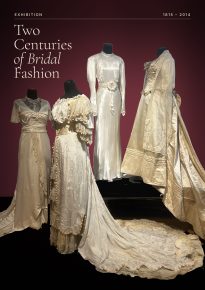


Everyone has been to a wedding. Few exhibitions speak to so many visitors at once, across every age, culture and background. Two Centuries of Bridal Fashion tells the story of the wedding dress through up to 100 original gowns drawn from one of Europe’s most important private fashion-history collections.
The journey begins with an English Regency silk gown of about 1815, from the years when the white wedding dress was still a novelty. Princess Caroline Bonaparte made it fashionable in 1800, and Queen Victoria made it a lasting tradition in 1840. Visitors then move through Victorian crinolines and bustles, Belle Époque lace, flapper-era tunics, 1930s bias-cut satin, Dior-inspired New Look silhouettes, Sixties minis and Eighties romance, up to contemporary couture. Along the way they discover the customs that lasted through two hundred years: the veil, the train, and the crown of orange blossom, a symbol that travelled from ancient China to the Victorian mantelpiece.
Every dress also has a human story. There are gowns worn by named brides from New York to Sarajevo, pieces that come from museum collections, and creations by Worth, Drecoll, Maggy Rouff, Jacques Heim and Oleg Cassini. Together they make the exhibition a portrait of two centuries of women, love and social change, as well as a history of fashion.
Up to 100 original wedding dresses dating from about 1815 to the 2010s, from France, Britain, the USA, Germany, the Netherlands, Turkey, Bosnia and Herzegovina, and Lithuania.
Gowns by the Lithuanian designers Juozas Statkevičius and Ramunė Piekautaitė, including one worn by the journalist Tatiana Pinskaya at her wedding (c. 2005).
Wide appeal: The exhibition draws fashion lovers, families, history audiences and engaged couples alike, and works across generations.
Commercial potential: The exhibition offers opportunities for wedding and event hire, Valentine’s Day and wedding-season programming, and dedicated photography spaces.
Scalable: Up to 100 dresses can be shown as one large exhibition or in smaller chronological selections to fit the space available.
Strong visual identity: The exhibition already has its own poster and a full image set, ready for press and social media.
• Up to 100 original wedding dresses, c. 1815 to the 2010s, from France, Britain, the USA, Germany, the Netherlands, Turkey, Bosnia and Herzegovina and Lithuania
• Regency rarity: an English empire-line silk gown with silk rosettes (c. 1815)
• Paris couture: Maison Drecoll (1916–17), Gustav Beer (c. 1918), a bridal silk dressing gown by the House of Worth (c. 1937), Maggy Rouff, Jacques Heim (c. 1963) and two gowns by Oleg Cassini, couturier to Jacqueline Kennedy
• Real brides, real stories: Andora Bucher's gown, worn at her wedding on 5 October 1893; Eliza Bennal's Victorian silk dress (1884); Reza Čengić's beaded gown, worn in Sarajevo on 27 December 1930
• Gowns with a story: a Schiaparelli-inspired New Look dress from a Vichy family linked to Napoleon III's court, and a gold-embroidered gown made to special order for Vogue (c. 1955)
• Iconic silhouettes: a Paul Poiret-style gown (1914), a Vionnet-style Art Deco dress (c. 1922), and a 1985 gown inspired by Princess Diana's wedding dress
• Complete bridal sets: a 1950 Parisian ensemble in its original box, and a 1925 Art Deco tunic with its celluloid orange-blossom crown
Please fill in the form to send your message. The owner of the listing will receive your enquiry and will then be able to answer you.
Please select the community profile of your partner and the type of partnership. Your partner will receive an email for confirmation.
Subscribe to receive regular industry updates every 2 months
Menu